Approvals And Requests
Approvals are how Gobii keeps humans in control. A Gobii can continue routine work, but it should pause when it needs a decision, sensitive access, or permission to change something important.
Common request types
| Request | What it means |
|---|---|
| Human input | Gobii needs a decision, answer, selection, or clarification. |
| Secret request | Gobii needs credentials or an environment-style value to use a service. |
| Contact request | Gobii wants permission to communicate with a person or endpoint. |
| Outbox review | Gobii prepared external email that must be reviewed before delivery. |
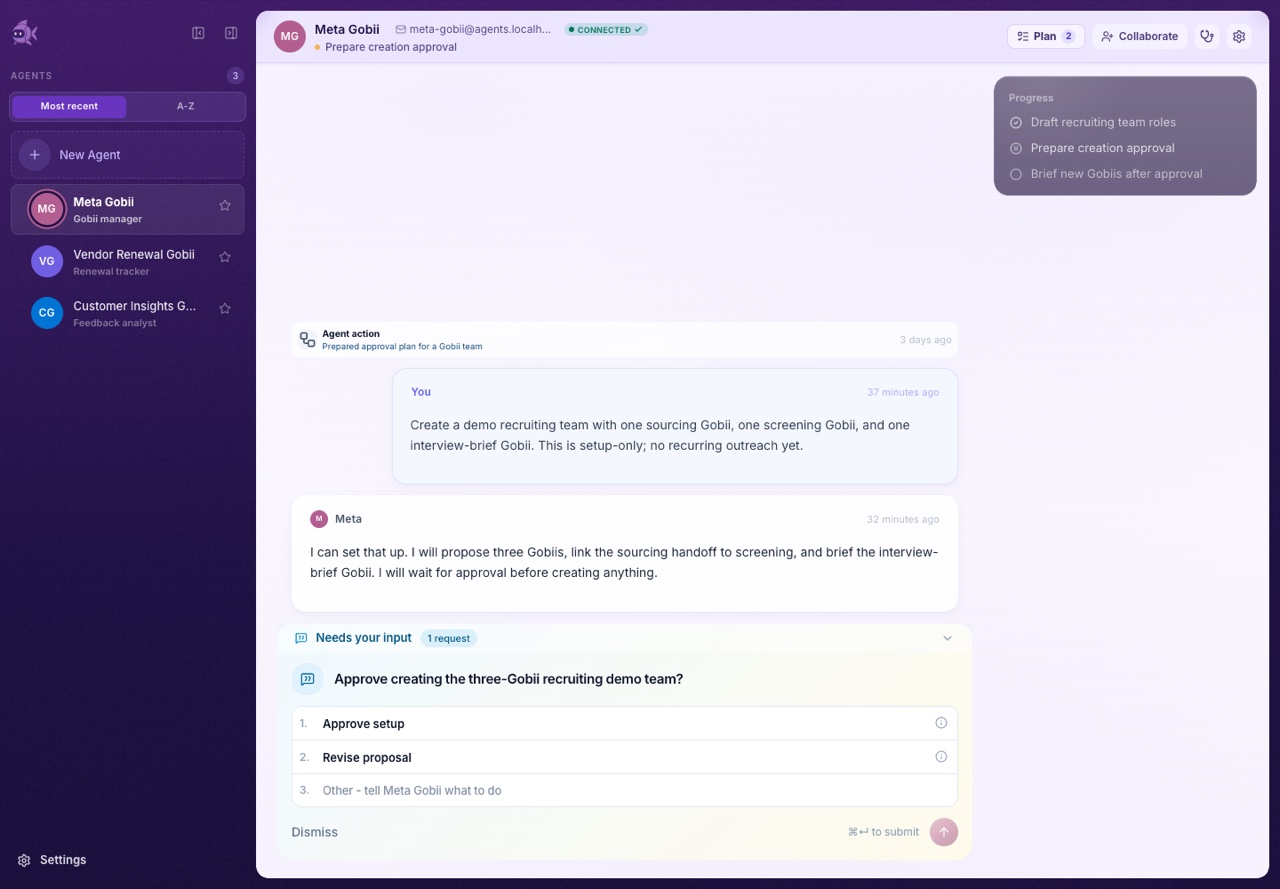
| Spawn request | Gobii or Meta Gobii proposes creating another Gobii. |
| Change approval | Meta Gobii proposes changing names, charters, links, files, contacts, schedules, or limits. |
How to respond
- Read the request and the reason.
- Check the scope: who, what, where, and for how long.
- Approve only if the request matches your intent.
- Reject or reply with a narrower instruction when the scope is too broad.
- Use secrets flows for credentials. Do not paste credentials into chat.
Example response:
Approve contacting Taylor only about the renewal spreadsheet. Do not add Taylor as a long-term contact yet.
Human input requests
Human input requests are ordinary decisions Gobii cannot or should not make alone. They may include options or a free-text answer.
Use them to clarify business judgment:
- Which account list should it use?
- Is the draft ready to send?
- Should a finding be escalated?
- Which vendor is the priority?
Credential and secret requests
When Gobii needs access, it may request a secret. Secrets are stored outside the chat transcript and can be scoped to a Gobii or promoted for broader reuse when appropriate.
Use Secrets And Credentials for the full model.
Contact requests
Contact approvals control who can talk to a Gobii and who a Gobii can contact. They help prevent accidental outreach.
Before approving a contact request, check:
- The person or endpoint.
- Whether inbound, outbound, or both directions are needed.
- Whether the contact should help configure the Gobii or only communicate with it.
- Whether the approval should be temporary or long-lived.
See Contact Access And Allowlists.
Outbox email reviews
When a Gobii's external email policy requires review, the email waits in Outbox until an authorized person approves or discards the exact version. Review the complete recipient list, subject, body, attachments, and warnings before approving. Email approval does not grant contact access.
See Review Before Send for policy options, editing, notifications, expiry, and failed-delivery retries.
Meta Gobii approvals
Meta Gobii can propose changes across Gobiis, but important mutations should appear in an approval plan before execution.
It should ask before:
- Creating a Gobii.
- Updating a name, charter, status, schedule, intelligence setting, or credit limit.
- Connecting or disconnecting Gobiis.
- Sending a brief to another Gobii.
- Adding or removing contacts.
- Uploading files.
- Archiving a Gobii.
See Meta Gobii.
Good approval language
Add approval boundaries to charters and messages:
- "Ask before contacting anyone outside our company."
- "Ask before using credentials on a new domain."
- "Ask before creating or archiving another Gobii."
- "Do not start recurring work unless I explicitly approve the cadence."
- "Do not spend more than the daily credit limit without asking."
Clear boundaries reduce surprises and make pending requests easier to evaluate.